"Shallows At Dusk" Wins Mitchell Environmental Conservation Award

“North Cove Shallows at Dusk” Wins John G. Mitchell Award

By markrogerbailey


“North Cove Shallows at Dusk” (2012) by Mark Roger Bailey

My photograph, “North Cove Shallows at Dusk,” has received the 2013 John G. Mitchell Environmental Conservation Award.

The award by the Land/Conservation Trusts of Lyme, Old Lyme, Salem, Essexand East Haddam (CT) honors the American environmentalist and former editor of National Geographic Magazine, John G. Mitchell (d. 2007). Past editor of Sierra Club Books and a longtime field editor and writer for Audubon Magazine, he also wrote many books, including LOSING GROUND (1975), ALASKA STORIES (1984), and DISPATCHES FROM THE DEEP WOODS (1991).

I captured this photo in Essex, CT late one April afternoon. The river bottom stones in the foreground, the larger boulders in the middle distance sharing the deepening water and the reflected glow of sunset spoke to me about the interconnectedness of our existence along the banks of one of America’s great rivers.

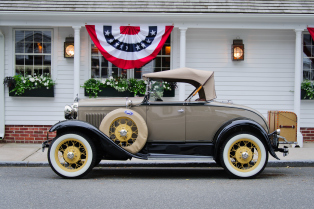
1930 Model A Ford_Mark RogerBailey

1930 Model A Ford parked under patriotic bunting before the Griswold Inn, Essex, CT (2012)

My photograph of an antique Ford automobile, “Model A Before Griswold Inn,” placed second in the Cultural Historic category.

Readers Rule

Nearly five months have flown by since I’ve posted here. That is too long.

I have been preoccupied with work, including launching the Robert Redford Conservancy for Southern California Sustainability at Pitzer College, hiring and integrating some fabulous new staff at the College, developing new initiatives including 50th Anniversary apparel, developing blogs for others, and producing marketing, advertising, promotions, and publicity for a variety of initiatives. For my own work, I’ve been producing new photography and developing distribution and writing. I am rewriting a novel for publication later this year.

It is notable how comprehensively the publishing industry and its business model have been transformed over the last 2-3 years. Blind submissions over the transom, the slush pile, weeks and months of waiting for agent and publisher responses to proposals, draconian publishing contracts, inventive royalty reporting… these fixed assets of the previous model have been supplanted by new energy, opportunity and visions for ways to connect with readers. Readers rule.

Writers who have stories to share can develop pathways to readers and, if their work interests them, if it engages on some level, a relationship begins. And if the writer has the energy, determination and persistence to develop more stories, and is open to learning and perfecting his or her craft, then s/he can offer another story, and maybe get a second date, and a third, and perhaps become a couple. How great is that?

Please check out some of the new work — and older titles you didn’t get an opportunity to read previously — coming online at:  Barnes & Noble     iBooks     Amazon Kindle

And, if you’re open to our getting to know each other better, check out my novel SAINT at:

Let me know what you think. Would you like to see what adventure Dr. Andrew Shepard is on now?


VIDEO: John Berger and Michael Ondaatje

Two important writers discuss story telling and the creative process in a conversation recorded courtesy of the Lannan Foundation.

I have read, been inspired by, and re-read several of these writers’ books. John Berger’s To The Wedding and Michael Ondaatje’s In the Skin of a Lion and English Patient are particular favorites of mine. This conversation was recorded at John Berger’s farm in Quincy, Mieussy, France, October 2002.  Enjoy…


Good Night, Earth

By markrogerbailey

Photographer Knate Myers compiled this amazing time-lapse video from stills captured by crew members on the International Space Station (ISS) and shares it with us on Vimeo.  The perspectives, scale, movement, and color are amazing.

Thank you, Knate.  This is inspired, and inspiring, work.

Images Courtesy of the Image Science & Analysis Laboratory,
NASA Johnson Space Center, The Gateway to Astronaut Photography of Earth
eol.jsc.nasa.gov

Music by John Murphy – Sunshine (Adagio In D Minor)
itunes.apple.com/us/album/sunshine-music-from-motion/id297702863

Related Links

Vimeo | Knate Myers

Knate Myers | Photography  (Zenfolio)

Resonance: Dreams give us lift . . .

Sometimes, a passage in a book stops us in our tracks. It might be that its meaning intersects with a personal moment of significance, or it states a truth so powerfully that we pause to appreciate the moment of connection. Here is one that caught my eye today.


Dreams give us lift …  The trick is to bear up after the weight of life comes back.

Ivan Doig
HEART EARTH (p. 133)

Your Brain on Fiction

NeuroFiction

An article in the New York Times published on Saint Patrick’s Day caught my attention for its premise: fiction improves our minds. I believe this to be true, but haven’t looked too deeply into the science of it. Science author Annie Murphy Paul has. Her article confirms my personal experience of the effect of reading fiction on mental, social and life skills.

AMID the squawks and pings of our digital devices, the old-fashioned virtues of reading novels can seem faded, even futile. But new support for the value of fiction is arriving from an unexpected quarter: neuroscience.

This got my neural processors firing away in anticipation of a good intellectual workout. Paul makes a compelling case for the power of the novel to engage, exercise and improve the brain.

The brain, the article reminds us, does not distinguish between imagining an experience as we read about it and actually experiencing it in real life. To the brain, one is as real as the other. This is a key principle of achieving excellence in any endeavor, practicing it in our minds so thoroughly that our mind cannot accept less than the perfect execution.  High performance athletes understand this. Jet fighter pilots who live or die by their trained responses know this. High steel workers and neurosurgeons also rely upon their finely honed disciplines. The fact that a good novel engages our mind and thrusts us into the heart of risk, danger, adventure, romance, achievement functions the way it does because our minds understand sensory details, evocative metaphors, and stimulating situations with such rich and complex experiences of reality that we discover and learn much as if we actually travelled, trained and risked as the novel’s characters do.

According to two scientific studies cited in the article, our experience of a novel hones our real-life social skills. The more we read fiction, the better we are able to understand other people, empathize with their challenges, and credibly see the world from their perspective.

Reading great literature, it has long been averred, enlarges and improves us as human beings. Brain science shows this claim is truer than we imagined.

Previously, I held this truth to be self-evident. Now, we have evidence that the novel literary form is pragmatic and has a basis in science.


Related Links

The Neuroscience of Your Brain on Fiction by Annie Murphy Paul, NY Times, March 17, 2012

Annie Murphy Paul | Science Author  –  TED     Nov. 2011

 Edited: 3 May 2021