Tablet and E-Reader Sales Soar

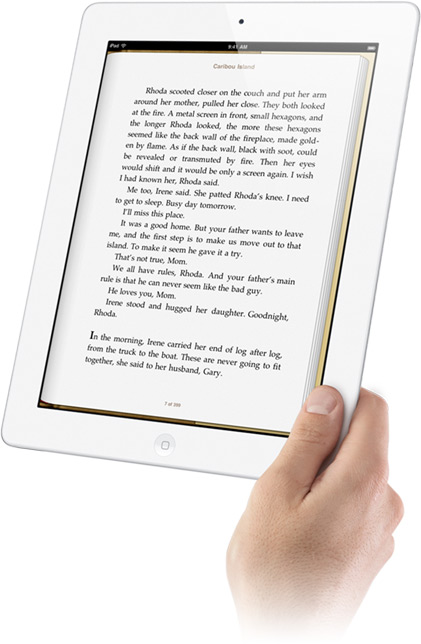
On a recent flight across the country, at least one in every 12 passengers were either reading or watching entertainment on tablets or smartphones. About 40% of these were reading books. About 1 in every 25 passengers were reading traditional books. This personal observation is anecdotal, of course, but it made an impression. That e-readers are becoming the new norm as personal digital devices become more intuitive, adaptive to personal needs, reliable and affordable is no longer news.

Then, a report from Pew Research and the American Life Project was released yesterday. The take-away from the NYTimes article: tablet and e-reader sales doubled over the last year.  Adult users increased from 10% of adults in Dec 2011 to 19% of adults in December 2012.  Increased ownership of tablets is especially pronounced among highly educated users with household incomes exceeding $75,000. In fact, nearly one third of people with college degrees own tablets.

As a writer, I’m pleased to see that many people are choosing to read when they have the opportunity. How they choose to read helps inform my thinking about how my stories should read on the page vs. screen, and how to focus my efforts to improve the reader experience.

Related Article

Table and E-Reader Sales Soar  |  NYTimes


Publishers Are Recovering

. . . While All About Them Are Losing Their Heads

Forget the myths: television did not doom the Hollywood blockbuster; video did not kill the radio star; the Internet is not ending the prime-time sitcom; and e-books will not shutter the publishing industry.

According to the recently released comprehensive survey, BookStats, the publishing industry expanded over the last three years while housing, autos, banking, the television networks, and our political institutions faltered.

Each industry adapted, some more successfully than others. Darwin’s theory of Evolution pertains. The weakest properties, channels, and business models have suffered, some to extinction — remember Microsoft BOB (1995)? Yet, good ideas took root. Smart, passionate innovators made them better with positive results. New media are multiplying audiences. Case in point: digital e-Readers.

Partly as a result of the sizzling pace of improvement of digital book devices and software, the e-book has rescued publishers, at least those able to perceive that consumer needs were changing and they could either adapt or find another line of work.  Unlike the recording industry’s resistance to home cassette recording and then Internet music sharing, the publishing industry saw the writing on the screen and a few publishers recalibrated their attitude and business model.

“We’re seeing a resurgence, and we’re seeing it across all markets — trade, academic, professional,” says Tina Jordan, vice president of the Association of American Publishers. “In each category we’re seeing growth.”

The Association of American Publishers and the Book Industry Study Group collaborated on the report, collecting data from 1,963 publishers the trade, K-12 school, higher education, professional and scholarly categories.

For the entire article in the New York Times, see  http://www.nytimes.com/2011/08/09/books/survey-shows-publishing-expanded-since-2008.html.


Storyselling: The Query

It is time to shake off the writing routine of the last year, and turn to marketing.

Storytelling to Storyselling

The discipline, focus, and skills that were so essential while writing the novel must now make way for business demands and professional responsibilities. Characters that have been present in every waking thought for so long now have competition for my attention. And so it is with sharpened senses; heightened awareness of current events, business trends, cultural tremors; and unflinching focus on the mission that I turn my attention to the all-important query.

A good query letter is a blend of copywriting, letter writing, business writing, and the finest creative brief writing, all balanced for clarity and purpose. A great query letter rises above to the level of message that ignites the imagination. This hybrid of writing craft and style is an Everest of a challenge. It must inform, establish credibility, entertain, and entice. The craft part can be fun. It is energizing to chisel away at the non-essential content in my drafts, like Michelangelo did with his block of Carrara marble 500 years ago until David stood naked in the piazza, as if he’d only been waiting for release from the stone. The art exists inside the clutter, and each bit of unnecessary verbiage that is cut away sharpens focus.

The first draft usually has a kernel of the desired power in it. There is a sense of the story’s marketing potential, yet this aspect requires different intellectual tools and skills that often feel foreign to the author who has for the past year been so immersed in research, experimentation, and passionate story-weaving. My letter may have have excellence within in it, yet seen from this new perspective, more work is needed to separate the wheat from the non-essential chaff.

My approach is to aim for three paragraphs:

Hook – the unique value proposition my book offers expressed in a succinct and engaging statement that captures the big idea in a way that resonates immediately;

Core elements - my book described in three talking points; and

Credits – a relevant professional credential to reinforce the confidence instilled in the preceding two paragraphs.

The goal is to spare the reader any of the process of the book’s creation.  It should be lean and purposeful, a clarion call to the reader to engage in the book.

No one knows the winning formula for the perfect query letter.  Like any relationship, the successful query is a happy mystery. A convergence of desire, hope, stagecraft, sincerity, belief, facts, fiction, charm, shared aspiration, willing suspension of disbelief, drama, humor, strength, vulnerability, intellect, nerve, sensory awareness, risk, hunger, selflessness, selfishness, and luck. It is ethereal and elemental. Ephemera and permanence. The editor dearly wants to be surprised and yet, to open themselves to surprise, first they must trust. If the letter arrived in a quality paper envelope, the address legible, the letter intact, and the single page inside emerges into the rarefied light of their office not too dense with gray type, you have metaphorically caught your correspondent’s eye and made it across the miles to stand before them.

Now what?

Who are you?

If this is my initial contact, I go for an arresting statement of fact that captures the essence of the book. If this is my response to their request for an outline or sample chapters, I remind him/her that I am responding to his/her request. Next, a spark of light on my credits. Something about why he/she can trust my work.

Then, that lean, mean, irresistible pitch in an understated, to-the-heart-of-it flow about secrets this book reveals, and where it takes the adventurous reader.

If I feel up to risking my reader’s patience with an extra paragraph, I’ll explain how my proposed book stands apart. I’m on thin ice here, but if I have the right stuff – a reference to one of his/her client’s works to which my work has a meaningful connection, for example – I may attract enough interest to inspire a second reading, and a sense of me that resonates a day or two later.

Finally, a simple and sincere request to send them a few sample chapters. Perhaps the entire manuscript? (This alerts the reader that the manuscript is complete.) Thank you, (editor’s name HERE). I look forward to hearing from you.

Sincerely yours, (judge for yourself whether sincerely is on pitch). Have you established an authentic connection for which sincerely is appropriate and reinforcing? If so, then sign off sincerely. If not, leave well enough alone and end with Thank You.

Sincerely,

M.R.B.

 

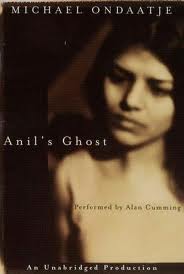
ANIL'S GHOST | Michael Ondaatje

Nothing Civil About This War

This novel was published after the phenomenon that was THE ENGLISH PATIENT. It is more grounded in human tragedy than PATIENT, and hews more closely to the female protagonist’s (Anil’s) story than PATIENT’s Hana.

Ondaatje’s achievement here is capturing horrible truths in asides. It is in the actions of supporting characters that he makes his case for the best and worst aspects of the human experience.

In THE ENGLISH PATIENT, Kip the sapper lives and works at the edges of the novel’s principal plot. Yet it is in his seemingly incongruent actions that he is so effective a presence. For example, he hoists Hana on a line into the high shadows of the Church of San Francesco in Arezzo so that she can glimpse the centuries-old frescoes. In doing so, he lifts her above the nightmare of Nazi occupation in WW-II Italy and transports her across time to the heights of mankind’s artistic triumph.

In ANIL’S GHOST, we are dropped into the terror of Sri Lanka’s civil war. There she is caught between three intractable forces: leftist and separatist insurrections and the government’s ruthless repression. Here she collaborates with two brothers – one an archealogist and the other a doctor. In their world, abduction is to be expected, torture is a fact of life, and the aspirations of their professions – discovery, knowledge, compassion – are dark and threatening ideas. They are ultimately loyal to these values, these abstractions of light, shadow, and hope.

It is especially relevant reading now, when what appears to be nascient civil war threatens the Middle East from Tripoli to Tehran.

GHOST is deeply researched and written. It is a good addition to the literature of our time.

Anil’s Ghost: A Novel

Related: Michael Ondaatje: Auteur, Author


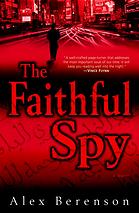
The FAITHFUL SPY | Alex Berenson

Auditioning new thriller authors is a gamble. We develop a relationship with selected authors, their characters, plots, and settings. Investing time in a complex literary reading experience written by a new author entails a leap of faith. Yet risk can pay.  Discovering a talented author who possesses a wealth of experience and who has so much to share is satisfying. While I’ve enjoyed thrillers by Tom ClancyAnthony HydeFrederick ForsythJohn LeCarre, and Daniel Silva, I was ready for new material and a fresh narrator’s voice.

I decided to try Alex Berenson’s writing. Berenson is a New York Times reporter who has covered stories ranging from the occupation of Iraq to the flooding of New Orleans to the financial crimes of Bernie Madoff. Reading his first novel, The FAITHFUL SPY (Jove paper 2008), looked like a good way to get acquainted.

The FAITHFUL SPY: Plot

John Wells is an American Central Intelligence Agency agent who, by all appearances, has gone over to the other side and is now a member of Al Qaeda. He has converted to Islam and is a devout Muslim. He has not been heard from in several years, yet the CIA takes note of occasional reports that a tall American matching Well’s description has surfaced in the company of Al Qaeda fighters.

John has earned the respect and trust of his fighters after years of sacrifice, living, fighting, and sacrificing as they do.  As the novel opens, he maneuvers his squad into an attack on American special forces in Afghanistan that he knows will devastate his team. All of his fellow fighters are killed by the Americans, and John ‘surfaces,’ revealing his identity complete with the code phrase that he has not used in many years, to notify Washington that he is still loyal to the CIA. From there, the plot moves to a planned attack in America, and his need to remain undercover to learn details from his secretive Al Qaeda handlers in the hopes of averting another disastrous attack on America.

In Langley, CIA administrators and managers distrust Wells. They don’t buy his story.  He is a rogue. There is little the bureaucrats fear more than individual initiative. All except for his handler, Exley, who believes in him, yet must tread carefully to avoid being kicked out of the the agency and everything she has worked so hard to achieve. Wells remains caught between America’s intelligence apparatus, law enforcement officials, and lethal Al Qaeda believers. He must operate effectively in both cultures and does so at great personal cost.

Ultimately, Wells confronts the Al Qaeda villain who drives a car bomb loaded with radioactive elements that will render several square miles of midtown Manhattan uninhabitable for a century.  The authorities who are hunting for Wells will certainly shoot first, and ask questions later.  It comes down to Wells against the fury of radical Islam on a street with no place to hide.  It will either be Wells or his Al Qaeda nemesis who survives, but not both…

The FAITHFUL SPY: Recommended. Berenson’s sure voice, direct writing style and pacing kept me turning pages. I look forward to reading the next.

The Faithful Spy (John Wells, No. 1)


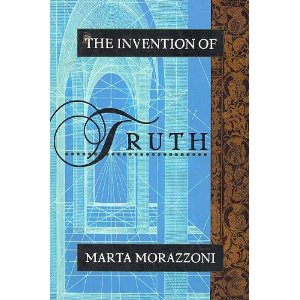
The INVENTION OF TRUTH | Marta Morazzoni

Passionately felt, skillfully written

The Invention of Truth (1995), by Marta Morazzoni was inspired by John Ruskin‘s quote: we can imagine falsities, we can compose falsehoods, but only truth can be invented, and interweaves two stories set in Amiens, France.

In the 11th century,  young Anne Elizabeth journeys to Amiens to assist Queen Matilda(1031-1083) in the embroidery of a tapestry that will later become known to the world as the Bayeux Tapestry. Her life is defined by this quiet encounter with the most powerful woman on earth.

In 1879, Victorian master art critic, John Ruskin (1819-1900), makes his final journey to Amiens where his experience inspires his book, The BIBLE OF AMIENS.

Both Anne Elizabeth and John Ruskin discover their individual ‘truths’ through their art. Anne Elizabeth experiences her proximity to the Queen more authentically through observations and appreciations of the Queen’s skill with her needle and thread than as a subject of the all powerful royal. John Ruskin touches the French soul and reveals himself most powerfully through his focus on French art.

Seven hundred years separate these two lives, yet the artist in you will recognize the theme that connects them.

Related Links

Amazon

The Free Library