What VOYAGER 2 and a Blog Post Have In Common

Voyager 2 – More like a blog post than I realized

The Voyager mission was designed to take advantage of a rare geometric arrangement of the outer planets in the late 1970s and the 1980s which allowed for a four-planet tour for a minimum of propellant and trip time. The flyby of each planet bends the spacecraft’s flight path and increases its velocity enough to deliver it to the next destination.

JPL Fact Sheet – California Institute of Technology

This technique of using the local planet’s gravity to accelerate the craft to the next planetary rendezvous is a little like viral theory.  The “gravity assist” technique, which was first demonstrated with NASA’s Mariner 10 Venus/Mercury mission in 1973-74, and shortened the flight time to Neptune from 30 years to 12 years, multiplies the forward momentum of the craft.  It also modifies the trajectory to expose the craft to new destinations.  A blog post that spreads from reader to reader and is re-blogged to new blogs builds its momentum forward to new destinations.

Whereas the astronomers and astrophysicists and other scientists at the Jet Propulsion Laboratory at Cal Tech can calculate the effect of trajectory and successive ‘gravity assists,’ we bloggers still craft a message to unknown recipients, publish it to the Internet, hope someone reads it and either responds or relays it forward so that another can read it… and respond. Better than a message in a bottle cast to the outgoing tide, but not yet as scientific or successful as exploration of interstellar space.

Weblog - Mission To The Unknown

A new weblog, familiar challenges

The desire to write, to think out loud, to write down a thought and launch it into the ether is a little like creating that golden disk containing voice and music recordings, bolting it to the fender of Voyager II, and hoping that some intelligent being somewhere in the far reaches of the Milky Way galaxy or beyond will come across it and pick up the thread.  Okay, writing a blog post is not very much like the $865 million effort required to launch Voyager and its message disk to interstellar space.  Yet you have to admit that both actions require a healthy dose of optimism.

Hello, from the children of planet Earth.

A group of us are working on a blog design that we hope will invite faculty, students, staff and alumni around the world to stop by, read, and respond. We hope that they will contribute their thoughts, comment and join in the conversation.

This is a challenge.  Design is a very personal, even intimate process. What one considers artful, another considers esoteric.  The elegance of one format is an obstacle to the urge for spontaneity in another.  Form either follows function or defeats it depending on your individual goals, which rarely come into focus until we see something and experience our reaction to it.  Fact is, until this moment in the collaborative act of creation, none of us have come to terms with our desires, wants and needs for this blog. Which is one of the benefits of process. Show me a creator of anything who gets it right the first time and I’ll show you a creator who aimed low.

When we previewed the blog design-in-progress for a group of smart and entrepreneurial students, it was met with clear interest, encouragement of its strengths, and helpful inquiries about ways to address its underlying potential for engaging the real-life needs of students, faculty, alumni and prospective students and their families.

Interactivity – can it be organized into  at-a-glance categories?  No one wants to scroll through a long page of disparate posts and comments to find something of interest.  We’re all busy.  Give us the top-ranking or most popular threads in politics, student life, music, news, and so forth.

In other words, edit content and format presentation.  Yes, this involves some processing of content in what was originally envisioned as an open, transparent, and unmoderated online dialog.  They acknowledged this.  They know their peers.  There will be the occasional ‘immature’ post, but that is life and it can be managed. More than anything, they were optimistic that the worldwide community of students, faculty and alumni would ultimately self-moderate.  I also believe that they will.  Recent research suggests that they have it right.


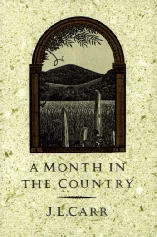
A MONTH IN THE COUNTRY | J.L. Carr

Quince Tree Press Edition - 1980

J.L. Carr captures a moment in time in England’s rural north.  The narrator is shell-shocked veteran, Tom Birkin, who tells of his weeks in Oxgodby in 1920 to restore a painting in the local church.  The Pastor is a bitter and misunderstood man; his wife is a caged beauty.  In a field nearby, another veteran, Charles Moon, digs for the bones of a 500 year-old victim of this village’s ancestors.  Tom’s summer in the almost surreal Oxgodby is the tale of restoration of wounded souls, how the answers we seek are so often within our reach, and crafted in English that is a delight to read and re-read.  I was reluctant to put this small book down.

J.L. Carr’s A Month In The Country is a quiet masterwork.

Booker Prize shortlist in 1980.

Note: This edition of the novel can be difficult to find.  First published in England in 1980, it has appeared in various small press editions since that time.  I recommend the illustrated Quince Tree Press edition.


GREAT HEART | Davidson & Rugge

GREAT HEART | Davidson & Rugge

It’s rare to return to a book a decade after reading it and find that it has grown, or more accurately, it has kept pace with my own evolution as a reader.  I am a more critical reader now, probably due to the flight of years. There are ever more books to read, yet less time in an increasingly busy chain of days.  Eleven years after reading GREAT HEART – The History of a Labrador Adventure I find I am once again transported by the story of Mina Hubbard’s fierce search for the truth about her husband’s death in Labrador’s unforgiving wilds.

I wrote an anonymous review of the book on Amazon in November, 1999, and upon returning last evening to see how the book is doing I discovered that my review is featured as the most helpful ‘positive’ review.  While I appreciate that other readers rated my comments as helpful, I was disappointed that other readers hadn’t long since eclipsed my own comments in support of this good book.

Here is what I said:

Using Leon and Mina Hubbard’s diaries, as well s those of their guides, Dillon Wallace and George Elson (great character!), Davidson and Rugge reconstruct the extraordinary story of a woman’s search for the truth behind her husband’s death in 1903.  They flesh out the facts, give form to the unspoken fears and desires hidden between the lines of desperate journal entries, and then skillfully breathe life into the tragic events.  A powerful docunovel in a class all its own.  Don’t miss it.

Others have been compelled by Great Heart. In 2000, author and freelance journalist, Alexandra J. Pratt attempted to retrace Mina Hubbard’s 1905  560-mile route by canoe through the sub-Arctic of  Canada’s Labrador, but a century of forest overgrowth defeated her team’s effort.  In 2002, Pratt published Lost Lands, Forgotten Stories, A Woman’s Journey into the Heart of Labrador.  I look forward to reading Ms. Pratt’s take on this story.


How Much Does Amazon Want?

From The Authors Guild: Amazon Accuses Someone Else of Monopolizing Bookselling

Amazon made it official yesterday, filing a brief in the Google case claiming that someone else might gain a monopoly in bookselling. It seems we're compelled to state the obvious:

Amazon's hypocrisy is breathtaking. It dominates online bookselling and the fledgling e-book industry. At this moment it's trying to cement its control of the e-book industry by routinely selling e-books at a loss. It won't do that forever, of course. Eventually, when enough readers are locked in to its Kindle, everyone in the industry expects Amazon to squeeze publishers and authors. The results could be devastating for the economics of authorship.

Amazon apparently fears that Google could upend its plans. Amazon needn't worry, really: this agreement is about out-of-print books. Its lock on the online distribution of in-print books, unfortunately, seems secure.

The settlement would make millions of out-of-print books available to readers again, and Google would get no exclusive rights under the agreement. The agreement opens new markets, and that's a good thing for readers and authors. It offers to make millions upon millions of out-of-print books available for free online viewing at 16,500 public library buildings and more than 4,000 colleges and universities, and that's a great thing for readers, students and scholars. The public has an overwhelming interest in having this settlement approved.

(Reprinted with permission of the Authors Guild)

Negotiation Tips For Writers

Close the Deal

Anyone who has dealt with an agent, a publisher, or a producer knows that negotiation is part of what makes the writing life possible.  As organizing principles go, this is pretty straightforward. While we have plenty to think about in negotiating representation, publication, and (hopefully) production, one goal should remain clearly in focus: close the deal.

Remember a Few Key Points

Robin Davis Miller, General Counsel of The Authors Guild, offered some advice on contracts and the negotiation process at a seminar in Los Angeles. I have benefitted from her counsel. I hope you benefit, too. Here are a few notes:

  • Publishing is a moving target. Change is constant.
  • NEVER accept assurances for marketing of your book on the website or anywhere else.  Get it in the contract.
  • Avoid the OPTION Clause.  Agents tend to leave it in because it ensures their commission even if you leave your agent and place the book yourself.
  • As the author, you deserve to know the publisher’s printing and circulation figures.  Publishers don’t release this information easily.  They fight it.  Remember – by the time they make an offer, they know precisely how many copies of your book they will print.
  • Research your agent’s and publisher’s reputation for using sub-rights.  Has the publisher executed for others?  Has your agent executed for other clients?
  • Time is your ally.  The more time that an agent or editor or publisher invests in you and your work, the more reluctant they are to let you go.
  • Books are a business.  Think and speak from a business point of view.
  • Insert an out of print clause anywhere the publisher attempts to punish the author for underperforming sales.
  • Always insist on receiving a statement. Have them e-mail it if they are reluctant to invest in postage. How else are you to know they are doing their job?

More Advice

Ernest Bevin (1881-1951), British politician and statesmen, offered:

The first thing to decide before you walk into any negotiation is what to do if the other fellow says no.


Novel Opening Lines

List-in-progress

One of the immeasurable benefits of novels is travel to other places and times with characters who begin as strangers and rapidly become part of our experience. How the author introduces us to a setting, a character, a premise, and occasionally even the designing principle of the literary work as a whole in a single sentence is a key moment.  Does the author establish a contract with us in that first line?  Or does s/he need a paragraph or a chapter to accomplish that?

Here are some distinctive opening lines.  There is no possible way to fairly represent all literature.  These are from my own reading, which scarcely scratches the surface.  I’m working on catching up, and hope that you will add suggestions from books you admire.  In that way, we can assemble a reading list for us all.

Opening Lines

He was an old man who fished alone in a skiff in the Gulf Stream and he had gone eighty-four days now without taking a fish.

Ernest Hemingway – The OLD MAN AND THE SEA (1952)


Call me Ishmael.

Herman Melville – MOBY DICK (1851)


A soft fall rain slips down through the trees and the smell of ocean is so strong that it can almost be licked off the air.

Sebastian Junger – The PERFECT STORM (1997)


One day in the spring of 1998, Bluma Lennon bought a secondhand copy of Emily Dickinson’s poems in a bookshop in Soho, and as she reached the second poem on the first street corner, she was knocked down by a car.

Carlos María Domínguez – The HOUSE OF PAPER (2004)


In that last winter of the war, she knew to use point blank ink.

Ivan Doig – HEART EARTH (1993)


Fedor Mikhailovich Smokovnikov, chairman of the Bureau of Fiscal Affairs, was a man who took pride in his incorruptible honesty and who was dismally liberal in his views; not only was he a freethinker, but he despised all form of religion, looking upon them as nothing but the relics of superstition.

Leo Tolstoy – The FORGED COUPON


The is the saddest story I have ever heard.

Ford Madox Ford – The GOOD SOLDIER (1915)


I started off this morning looking for a lost dog.

Gretel Ehrlich – Looking For a Lost Dog, from ISLANDS, The UNIVERSE, HOME (1991)


Floating upward through a confusion of dreams and memory, curving like a trout through the rings of previous risings, I surface.

Wallace Stegner – CROSSING TO SAFETY (1987)


“Yes, of course, if it’s fine tomorrow,” said Mrs. Ramsay.

Virginia Woolf – TO THE LIGHTHOUSE (1927)


In some distant arcade, a clock tower calls out six times and then stops.

Alan Lightman - EINSTEIN'S DREAMS (1993)


To Teens, Knowledge is Infinite

Child is Father/Mother...

Despite the rancor at town hall meetings across an increasingly stressed America, there is some very good news coming from a hopeful source: high school students and rising college first-year students.  While so many adults are indulging in anti-social rage against change, their children are quietly learning, preparing, observing and developing their personal life plans.  From the look of things, they are choosing change, seeing promise in lifelong learning, knowledge as infinite, and following discovery where it leads as long as it results in good - for themselves, their families, their communities and their planet.

In a related article by Tamar Lewin about the rapidly diminishing importance of textbooks in high school education, there is an intriguing subtext that made me sit up and pay attention - students are relating to the world they are inheriting in a productive way that contrasts with their elders' approach.  If you get a moment, read In a Digital Future, Textbooks Are History (NYT, 9 Aug 2009).

e-Publishing Opens Doors for Authors

Good Times

Just as when the IBM personal computer arrived (1981), Steve Jobs introduced the Macintosh with GUI (1984), the venerable Selectric and Selectric II became obsolete, and a universe of entrepreneurial and artistic opportunities opened to writers, the Kindle, Sony Readers, iRex, Lexcycle's Stanza and other downloadable readers have opened doors to a new world of publishing possibilities. While the major players sort out the e-Publishing landscape, engineer the infrastructure, and build the new e-pub world, we writers are exploring, beta testing, and blazing new entrepreneurial paths ... all while continuing to write, write, write. This is a good time to be a writer, don't you think?

Kindle UPDATE - Kindle vs. B&N Free eReader:  See David Pogue's PERSONAL TECH column, "New Entry in E-Books a Paper Tiger," in the August 6th edition of the New York Times.  Barnes & Noble's new e-reader offers PC access to e-books.  The eReader tablet itself is promised for later.

Kindle Posting 1: Most Systems 'Go'

Tuesday 1:40 pm: Pilot-tested Kindle publishing with a short story.  Katey Hoagland runs 1,200 words/seven pages, and seems like the best candidate for a test in which I was prepared to load the file, fail, reload, refine HTML, unload and reload again many times according to almost every blog post I read.  Found Amazon's Digital Text Platform (DTP) to be intuitive and easy-to-use. KH lg 2

I completed the title, product description, tags, and uploaded the story manuscript (MsWord.doc file/Mac OS X (10.5)/Firefox).  DTP's conversion tool churned for about 40 seconds and notified me that Katey Hoagland was successfully converted. Reviewed the file, noticed that paragraph indents were uniformly eliminated, but that was the only revision to the manuscript.

DTP Dashboard displayed the message: 'Publishing Katey Hoagland. Your content is being published. Most titles take between 1 to 2 hours to become buyable.'

Tues. 3:20 pm: Katey Hoagland appears in the Kindle Store online, without product description, but otherwise as expected.

Wed. 9:00 am: DTP Dashboard still displays 'Publishing Katey Hoagland. Your content is being published...' message.   As a result, I'm unable to access the file for this upload so that I can learn more about what is happening (or not happening).  Not sure if I should wait longer for DTP to come around or if I should simply repost.   e-Mailed dtp-feedback@amazon.com request for assistance.

Wed. 9:00 pm: Dashboard remains unresponsive.  dtp-feedback@amazon.com just responded and confirmed that my upload is active, they will be adding my product description, and they will follow-up to confirm again in 1-2 business days.

Thurs. 10:30 am: Received e-mail from dtp-feedback@amazon.com confirming active account status, and intention to post product description.

Fri. 07:30 am: Product description displays on listing in Kindle Store.  Dashboard functioning properly.

2010-01-14  Thurs.  20:15: Katey Hoagland has turned the head of at least one acquiring editor.  So, Katey is coming back home for now.  I de-listed her story from Amazon's Kindle offerings.