
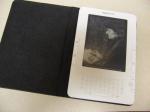
Kindle & The Evolution of a Writer

1d8de03ae7a0967b140bf110

Big Bangs

In the hyper-paced evolution of consumer technologies, there are few developments that equal the transformative effects of e-publishing.

Traditional publishing is now adapting to the reality of the Kindle, Sony e-reader, iPod Touch, and iPhone, which are being adopted by consumers at a rate not seen since the invention of the wheel. I wasn't present during that paradigm shift, but it is reasonable to assume that the Mesopotamians in the 5th millenium BC 'got it' and didn't look back wistfully to the old, pre-wheel, pre-personal empowerment days.  Now, once again in humankind's evolution, we have a better idea that has authors and readers leapfrogging industry.  Publishers have cultivated content and fed readers' appetites.  But they have become a little too comfortable with the perquisites of the traditional corporate model, like Detroit automakers, the Big Three television networks, and the music industry.  In each case, we the people have found our way to a better idea, a better way.

Now Amazon's Jeff Bezos is betting on the Kindle as a market maker, and if the rapidly increasing sales of the e-book tablet keep growing at the pace they have in the last year, he may be the man we credit with a Steve Jobs-like vision that changed the way we consume media content.

Heads Up: Prices Falling

Publishers see the change happening, know that their traditional print business model is struggling and have apparently decided to profit from the chaos in the book selling market by charging similar prices for hardcover and e-books. Today at Borders, I overheard a salesperson explaining e-books to a middle-aged couple at the Sony E-Reader display this way.

"E-books are coming down in price to roughly half the cost of a hardcover, from $15 to $17."

The couple were eager for the convenience offered by the E-Reader and when they heard about the cost-savings on titles, they decided to purchase the Sony.

Maybe I should have intervened and told them about $9.99 titles at Amazon.  You don't criticize someone's family when you're a guest in their living room; and I won't disrupt Borders' business when I am in theirs.  The couple are happily curled up on their couch now with Dan Brown's Lost Symbol on the E-Reader.  Everyone is happy.  As for the pricing, publishers will hang on to their profit margins and will change only when their business infrastructure collapses around them.

Meanwhile, over at Amazon, Jeff Bezos is offering e-books for download to the Kindle for $9.99.  Amazon may lose on the margin in the near term, but it is establishing the $9.99 price point for books much in the same way that Steve Jobs established .99 cents as the single unit price point on iTunes, which is now the worldwide standard. More rapid adoption by more consumers will more than make up the difference.

More significantly to me, e-publishing redefines the business model.  Suddenly, the artist and writer can, if they wish, become their own publishers.  No more expenses like printing, shipping, trucking, warehousing, distribution, freight, fuel.  It's irresistible and, as Adam Penenberg says in his article "The Evolution of Amazon" in the July/August edition of Fast Company, "it's irreversible."   Literary agent Richard Curtis, who is also founder of E-Reads, an independent book publisher, asks,

why would "anybody need a traditional book publisher when you can essentially make Amazon your buyer and your seller in one stroke?"

iPublish

After years of playing by Publishing's rules - willingly, loyally, and with respect for its professionalism - the time has come to try other approaches to connect with my readers.  I am going to try posting a story or two in Amazon's Kindle Store and see if I can reconnect with former readers and meet some new readers.  I'll let you know how it goes.

Creative Writing & The Money Myth

Creative Writing

What is creative writing?  Opening to an idea, following where it leads, exploring it, getting inside it and crafting a way to bring it alive through story.  Creative writing is observing a subject, its strengths, weaknesses, contexts, perceptions and misperceptions about it, wants, needs, identity, senses... the full spectrum of facts. Then writing a story, poem, screenplay, stageplay, or novel in an imaginative way that is characterized by originality and expressiveness.

Why write? Developing an idea into a concept, then into a premise, and then writing about it is Sisyphean, like hauling a wheelbarrow up K2. No one undertakes this lightly. So why do it? Often, the ambition sprouts from a fertile childhood, a sense of otherness from earliest memory, or distinctive experience. Maybe something as simple as an insatiable curiosity to learn and understand. Michael Chabon ( in Imaginary Homelands, which first appeared in Civilization) describes it:

I write from the place I live: in exile.   ...    I bear no marks or scars. I haven't lost anything that isn't lost by everyone.

And yet here I am - here I have always been, for as long as I can remember knowing anything about myself - feeling like a stranger.

For his entire life, he says he has been engaged in

One search, with a sole objective: a home, a world to call my own.

The Money Myth

Charles Dickens, Sir Arthur Conan Doyle, and Samuel Johnson ("No man but a blockhead ever wrote except for money") notwithstanding, no writer starts writing for the money.  For most if not all of the writers I know there is never any rumuneration equal to a living wage for the work invested in a novel. "If you would be a reader, read; if a writer, write," said Epictetus.  Novelists write to learn, to understand, to experience, to entertain, to create a world in which to live. That's pretty much the sum of it.

"The Ledge" | Lawrence Sargent Hall

Several years ago, Yannick Murphy (The Sea of Trees, 1997; Signed, Mata Hari, 2007) recommended Lawrence Sargent Hall’s (1915-1993) short story, “The Ledge,” when I was her student in the Master of Professional Writing program at the University of Southern California.  She did me an important favor for which I remain grateful.

This story continues to resonate over time and after successive readings. Published in 1959, “The Ledge” won first place in the O. Henry Prize Collection of 1960 and has appeared in dozens of anthologies since that time. Hall’s lean, vivid prose establishes a reliable sense of place and time. His fallible characters are compelling. And “The Ledge” has a narrowness of time and event that focuses the mind and holds that focus. It also has a strong point of view, clarity of theme and premise, and the poetry of natural detail. I mention it here in case you haven’t already read it and are looking for inspiration.

LAWRENCE SARGENT HALL was educated at Yale and worked as an English professor at Bowdoin College for more than forty years. Based on actual events and initially rejected by Esquire and The New Yorker, “The Ledge” was selected by John Updike as one of the best short stories of the century. Hall also published the novel The Stowaway in 1960. He died in 1993.

AUDIO: Lawrence Sargent Hall reads “The Ledge” in this 1959 recording at Bowdoin College. 

Updated: 10 Jan 2021

The Last :05 Seconds

If I can’t write the final beat of a story, brief, or article, or the last five seconds of a commercial or video, I know that the premise is not yet fully realized. Those concluding seconds, or those cascading syllables leading to a final conclusive sustaining note should resonate.  The end should resolve, summarize and underscore the point.  If those qualities are absent or not sufficiently present, then the foundational work – the premise in most instances – is not done; the ad, video, short story, screenplay or novel is not complete. The piece might move, twitch, even walk, but it won’t fly.


Dramatic Structure | Aristotle

Just reviewing my notes about structure written when I was halfway through my third novel (as yet unpublished). Aristotle… good material.

Classical Unities

1. Single Place

Aristotle called this Unity of Place:  he recommended that no play should cover more than one physical space; and definitely should not get into gimmicks like compressing geography or representing more than one space on the stage.

2. Single Action, Objective, Challenge

Aristotle called this Unity of Action: he recommended that the story (play) have one main action, with few or no subplots.  Can you imagine a primetime hourlong with only one plot?  Samuel Beckett’s play, Waiting for Godot, comes to mind – two men, Vladimir and Estragon, waiting for Godot by a tree along a deserted country road.  A few sitcoms have attempted it (i.e., Mad About You in which Paul and Jamie wait by the bedroom door for the baby to fall asleep).

3. Brief Time (a.k.a. ‘time lock’)

Finally, Aristotle suggested – you guessed it, in his Unity of Time – that no play should cover events representing more than 24 hours of time. Hmmm… so a season of 24 actually represents the Aristotelian ideal, right?  Each episode follows Jack through exactly one hour of his challenging existence.  That’s a time lock.  Yet, at the risk of nitpicking, while he follows one overarching action, he is all over the world trying to achieve it.  My guess is that Aristotle wouldn’t judge 24 too harshly.  The structure works.

Hemingway’s For Whom The Bell Tolls is another example of the essential power of Aristotle’s Classical Unities:

1. Strategically important BRIDGE in war-torn Spain
2. Jordan must DESTROY the bridge
3. He has 3 days in which to achieve his objective… 72 hours

Apply that to just about any story and you see the pattern. There IS method!  How many times must we rediscover what we know?

One Chance

Pamela Dorman, vice president and publisher, Pamela Dorman Books/Viking, a division of Penguin Group, moderated a publishing seminar recently entitled, "Between Milk and Yogurt": Book Publishing Today. One of the takeaways for me was this:

a writer gets one chance.

Even if the editor engages and provides encouraging notes to the author about his/her manuscript, perhaps even suggesting that it could work if certain changes were made.

The fact is that no editor has time to read material twice - even if the manuscript is completely rewritten. Don't resubmit 1, 2 or 3 years later. No one has time. You get one chance.


That reads more harshly than it came across. Ms. Dorman and her panelists were unfailingly positive about their professions, yet recognized that publishing is, after all, a business.

Ms. Dorman, the publisher who successfully persuaded author Helen Fielding to entrust her with her novel, Bridget Jones's Diary, in the American market, recounts how she did it.

TO THE LIGHTHOUSE | Virginia Woolf

Virginia Woolf transformed the art of the novel with To The Lighthouse.

There are few words available to me to describe this work satisfactorily. I will, however, try. It is brilliant, moving, humbling and inspiring.

To The Lighthouse is a transcendant work by a woman who knew no relief from the burdens of great talent, who labored to sharpen her writer's instrument until she could express the inexpressible, who continued to write truth while every force of the universe laid siege to her attentions. Still, she looked close and described what she witnessed patiently, attentively and with an unbreakable will to create a reality that made obsolete every achievement that preceded her.

To The Lighthouse studies the interplay of forces at work in a family in its anticipation of its season at the shore on the Isle of Sky in Scotland. It observes the tangle of realities experienced by individual members of the Ramsay family at the shore. It even focuses on the subtlest details of the family's cottage through the seasons. The novel pulses with possibility like the rhythmic sweep of the lighthouse's searing light and its pregnant gothic shadow.

Virginia Woolf masterfully orchestrates the details of inner furies and ocean weather systems, of seasonal shifts, of ephemeral dreams and desires and the leaden facts of everyday compromise. She wrote a masterwork. 

*

In 1998, the Modern Library named To the Lighthouse No. 15 on its list of the 100 best English-language novels of the 20th century.[1] In 2005, the novel was chosen by TIMEmagazine as one of the one hundred best English-language novels from 1923 to present.


Harvest/ Harcourt, Copyright 1927, renewed by Leonard Woolf 1955.