

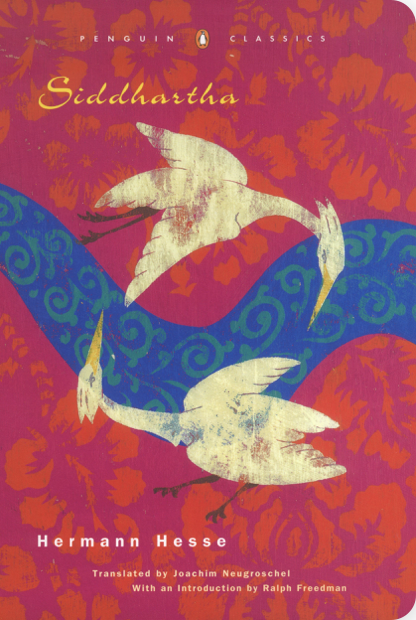
A bold translation of Nobel Prize winner Hermann Hesse’s most inspirational and beloved work in a Penguin Classics deluxe edition. Nominated as one of America’s best-loved novels by PBS’s The Great American Read
That Herman Hesse undertook a journey tale is admirable; that he did so in lyrical prose amidst WWI’s nightmarish aftermath and his personal crises is impressive. That he created a relevant and cohesive story about an ascetic from privilege is bold and engaging.
Siddhartha learns from Samana ascetics, Gautama the Awakened One, Kamaswami the merchant, the sensuous beauty Kamala, Vasudeva the ferryman and failure itself. While most seekers find their place with lower-level teachers, Siddhartha gains all possible knowledge from each, grows dissatisfied, and moves on to others who fulfill the next stage of his quest for more comprehensive experiences. Vasudeva’s wisdom breaks through to Siddhartha, who learns to listen to the river and discovers that most teachings reduce the universe to binary understandings. Even Buddha divides the whole into two halves: samsara and Nirvana, illusion and truth, sorrow and salvation, as the path to enlightenment.
Siddhartha deepens his understanding of the universal and comes to see the world’s reality as a whole. Time itself is a human illusion. And the spans between world and eternity, between sorrow and bliss, and between evil and good are also illusions. As he explains to his seeker friend Govinda, “the stone in time will become soil and will, from soil, become a plant, or an animal or a human being.” In this sense, his previous experiences and realities, as well as what he will become, are part of his and the universe’s whole reality. Siddhartha has learned that every iteration of his being has been a discrete aspect of his whole being — good and bad, virtue and evil, honor and selfishness — and is a true and real understanding of his greater being. In this state of elevated awareness, he accepts and loves every element of every being.
Quisque iaculis facilisis lacinia. Mauris euismod pellentesque tellus sit amet mollis.