The END OF THE ALPHABET | C.S. Richardson

Collectible First Novel 

This story is unlikely.

So begins the first novel by C.S. Richardson, creative director at Random House Canada, award-winning book designer, and now, author. The story works on multiple levels, following the personal journeys of two individuals and discovering along with them the rare love they share. Having found each other, Ambrose Zephyr, 50-year-old advertising creative, and Zappora ‘Zipper’ Ashkenazi, fashion magazine columnist, are content in their narrow London terrace full of books when Ambrose learns that he is ill and has 30 days to live. Stunned and reeling, they depart from their home in Kensington Gardens and embark on an expedition ‘to the places he has most loved or has always longed to visit, from A to Z. Amsterdam to Zanzibar.’

Ambrose attempts to both escape his fate and accept whatever is to come next. Zipper discovers new depths of strength in herself as she overcomes her panic and creates ways to be there for him, witnessing his disintegration.

At the end Zipper is lost in the silence, the vacuum of deep space without the only man she ever loved.

She opens the journal that she purchased in Amsterdam on the first stop of their great expedition, takes in the emptiness and begins to write…

This story is unlikely.

THE END OF THE ALPHABET has some qualities of a classic.  It is visually captivating, surprises the reader by launching from a familiar premise yet takes flight into new situations, and is told in a discerning and disarming literary style.

The End of the Alphabet (2007), Doubleday, 119 pages


The WINDY DAY | Rick Bass

Wild Hearts

Bass mirrors the rush of life emergent in this story, The Windy Day, from his collection about wild hearts grounded in Nature entitled, The Lives of Rocks.

The narrator and his four-month-pregnant wife, Elizabeth, set out for town during a wind storm to learn the gender of their fetus.  Every hundred yards, they must stop to clear the road of fallen timber.  The father-to-be narrator fires up the chain saw and cuts and cuts and rolls, then gets back into the truck and moves on until they must stop again and cut, cut, roll.  It takes them an entire day (read lifetime) to reach the main road to town.  As darkness falls, the father-to-be is ready to keep going; he feels he is making progress and is intent on beating the odds.  Elizabeth says no, they’ll try again tomorrow.

Our father-to-be looks around him and imagines 16 years into the future when he and his daughter will ride horses through these woods, jumping over these fallen logs, or hauling the logs with his sixteen year old son…


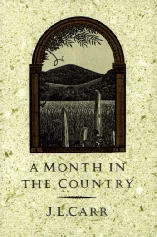
A MONTH IN THE COUNTRY | J.L. Carr

Quince Tree Press Edition - 1980

J.L. Carr captures a moment in time in England’s rural north.  The narrator is shell-shocked veteran, Tom Birkin, who tells of his weeks in Oxgodby in 1920 to restore a painting in the local church.  The Pastor is a bitter and misunderstood man; his wife is a caged beauty.  In a field nearby, another veteran, Charles Moon, digs for the bones of a 500 year-old victim of this village’s ancestors.  Tom’s summer in the almost surreal Oxgodby is the tale of restoration of wounded souls, how the answers we seek are so often within our reach, and crafted in English that is a delight to read and re-read.  I was reluctant to put this small book down.

J.L. Carr’s A Month In The Country is a quiet masterwork.

Booker Prize shortlist in 1980.

Note: This edition of the novel can be difficult to find.  First published in England in 1980, it has appeared in various small press editions since that time.  I recommend the illustrated Quince Tree Press edition.


The Last :05 Seconds

If I can’t write the final beat of a story, brief, or article, or the last five seconds of a commercial or video, I know that the premise is not yet fully realized. Those concluding seconds, or those cascading syllables leading to a final conclusive sustaining note should resonate.  The end should resolve, summarize and underscore the point.  If those qualities are absent or not sufficiently present, then the foundational work – the premise in most instances – is not done; the ad, video, short story, screenplay or novel is not complete. The piece might move, twitch, even walk, but it won’t fly.