
The WINDY DAY | Rick Bass

Wild Hearts

Bass mirrors the rush of life emergent in this story, The Windy Day, from his collection about wild hearts grounded in Nature entitled, The Lives of Rocks.

The narrator and his four-month-pregnant wife, Elizabeth, set out for town during a wind storm to learn the gender of their fetus.  Every hundred yards, they must stop to clear the road of fallen timber.  The father-to-be narrator fires up the chain saw and cuts and cuts and rolls, then gets back into the truck and moves on until they must stop again and cut, cut, roll.  It takes them an entire day (read lifetime) to reach the main road to town.  As darkness falls, the father-to-be is ready to keep going; he feels he is making progress and is intent on beating the odds.  Elizabeth says no, they’ll try again tomorrow.

Our father-to-be looks around him and imagines 16 years into the future when he and his daughter will ride horses through these woods, jumping over these fallen logs, or hauling the logs with his sixteen year old son…
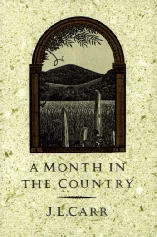
A MONTH IN THE COUNTRY | J.L. Carr

Quince Tree Press Edition - 1980

J.L. Carr captures a moment in time in England’s rural north.  The narrator is shell-shocked veteran, Tom Birkin, who tells of his weeks in Oxgodby in 1920 to restore a painting in the local church.  The Pastor is a bitter and misunderstood man; his wife is a caged beauty.  In a field nearby, another veteran, Charles Moon, digs for the bones of a 500 year-old victim of this village’s ancestors.  Tom’s summer in the almost surreal Oxgodby is the tale of restoration of wounded souls, how the answers we seek are so often within our reach, and crafted in English that is a delight to read and re-read.  I was reluctant to put this small book down.

J.L. Carr’s A Month In The Country is a quiet masterwork.

Booker Prize shortlist in 1980.

Note: This edition of the novel can be difficult to find.  First published in England in 1980, it has appeared in various small press editions since that time.  I recommend the illustrated Quince Tree Press edition.


The Last :05 Seconds

If I can’t write the final beat of a story, brief, or article, or the last five seconds of a commercial or video, I know that the premise is not yet fully realized. Those concluding seconds, or those cascading syllables leading to a final conclusive sustaining note should resonate.  The end should resolve, summarize and underscore the point.  If those qualities are absent or not sufficiently present, then the foundational work – the premise in most instances – is not done; the ad, video, short story, screenplay or novel is not complete. The piece might move, twitch, even walk, but it won’t fly.